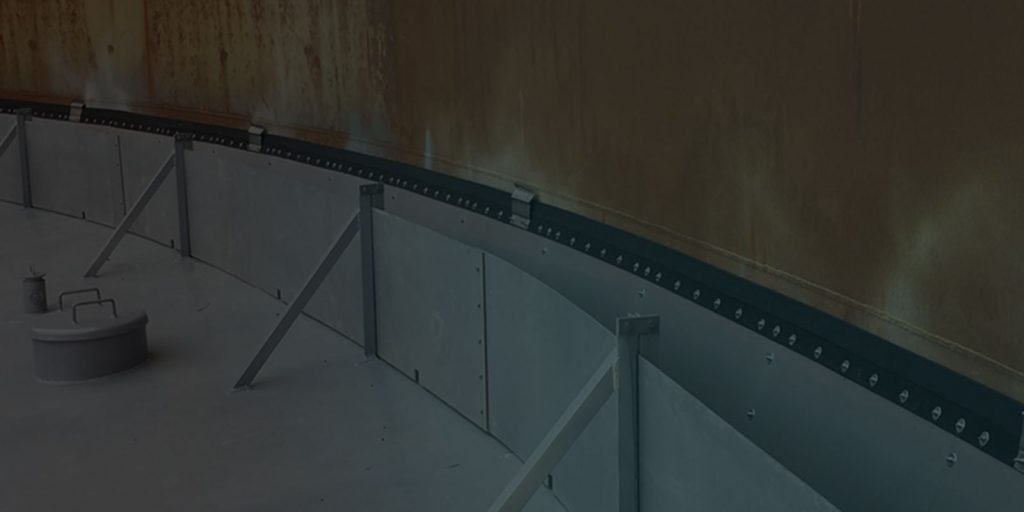
What Is a Floating Roof Tank Sealing System and What Is Its Purpose?
A floating roof tank sealing system is one of the most critical components for the safe and efficient operation of petroleum, petrochemical, and chemical storage tanks. By providing an effective seal between the floating roof and the tank shell, this system plays a vital role in reducing product evaporation, preventing the release of flammable vapors, enhancing operational safety, and ensuring compliance with environmental regulations.
Proper engineering design and professional installation of the sealing system significantly increase tank service life while reducing maintenance and repair costs.
Leveraging extensive engineering expertise, industrial project experience, and adherence to internationally recognized standards,
Negin Javid Rasta specializes in the fabrication and installation of floating roof tank sealing systems. Our services include the design, manufacturing, and installation of
Mechanical Seal and
Tube Seal systems tailored to each tank’s specifications, operating conditions, and stored product characteristics. Our objective is to deliver safe, reliable, and cost-effective sealing solutions that improve tank performance while minimizing operational risks across the oil, gas, and petrochemical industries.
Importance of Using Sealing Systems in Floating Roof Tanks
A floating roof tank sealing system plays a crucial role in vapor emission control, operational safety, and overall tank performance. Since these tanks typically store petroleum products, chemicals, and other volatile or flammable liquids, maintaining an effective seal between the floating roof and the tank shell is essential.
Proper selection and installation of the sealing system not only improve operational efficiency but also minimize technical, environmental, and financial risks throughout the tank’s service life.
The primary benefits include:
- Reducing evaporation losses of stored petroleum and petrochemical products
- Preventing the release of flammable and hazardous vapors
- Improving operational safety under varying operating conditions and liquid levels
- Meeting environmental regulations and reducing industrial air pollution
- Ensuring smooth floating roof movement against the tank shell
- Minimizing shell corrosion caused by vapor exposure and environmental conditions
- Extending the service life of the tank and associated equipment
- Reducing long-term maintenance and operating costs
- Complying with international standards, including API requirements and HSE regulations
Selecting the appropriate sealing system—particularly Mechanical Seal or Tube Seal—ensures safe, reliable, and long-lasting performance under various operating conditions.
Applications of Floating Roof Tank Sealing Systems
Floating roof tank sealing systems are widely used to minimize product evaporation, prevent vapor leakage, improve operational safety, and reduce product losses.
These systems are extensively applied in:
- Oil terminals
- Gas facilities
- Petrochemical plants
- Refineries
- Chemical processing plants
- Power plants
- Bulk liquid storage terminals
Negin Javid Rasta provides customized Mechanical Seal and Tube Seal solutions designed to satisfy the specific operating requirements of each industry.
Types of Floating Roof Tank Sealing Systems
Floating roof tank sealing systems are designed to seal the annular space between the floating roof and the tank shell. Their primary purpose is to prevent vapor leakage, reduce product evaporation, and improve operational safety.
Depending on the stored product, operating conditions, tank diameter, and applicable engineering standards, different sealing systems are available. The two most common and widely adopted solutions are:
- Mechanical Seal Systems
- Tube Seal Systems
Selecting the appropriate sealing system has a direct impact on tank performance, equipment longevity, and maintenance costs and should always be based on detailed engineering evaluation.
Mechanical Seal System
Mechanical Seal is one of the most common and robust sealing solutions for floating roof tanks. It consists of metallic components and mechanical sealing elements that maintain continuous contact with the tank shell while accommodating roof movement and shell dimensional variations.
Mechanical seals are typically recommended for tanks operating under demanding conditions involving higher temperatures, elevated pressures, or highly volatile and corrosive products.
Their major advantages include:
- Excellent mechanical strength
- Long-term durability
- Stable performance under varying operating conditions
- Reliable sealing efficiency
For these reasons, Mechanical Seal systems are widely utilized in oil, gas, and petrochemical facilities.
Tube Seal System
The Tube Seal system is an advanced sealing solution utilizing flexible elastomeric tubes positioned between the floating roof and the tank shell. The inflated tube creates uniform sealing pressure that effectively prevents vapor emissions and product leakage.
Due to its flexibility, the Tube Seal system can easily accommodate shell irregularities and changing liquid levels while maintaining excellent sealing performance.
Its key advantages include:
- High flexibility
- Effective adaptation to shell irregularities
- Excellent vapor loss reduction
- Lightweight construction
- Faster installation
- Cost-effective solution
Consequently, Tube Seal systems are widely used in petroleum and chemical storage tanks where economical yet efficient sealing performance is required.
Comparison Between Mechanical Seal and Tube Seal
Selecting between Mechanical Seal and Tube Seal depends on several factors, including:
- Stored product characteristics
- Operating conditions
- Safety requirements
- Project specifications
- Budget and lifecycle costs
Each system offers unique structural and operational advantages.
Generally:
- Mechanical Seal is preferred for severe operating conditions and projects requiring maximum safety and durability.
- Tube Seal provides a more flexible, economical solution with excellent evaporation control.
The detailed technical comparison is presented in the following table:
| Features | (Mechanical Seal) | سیل (Tube Seal) |
| Structure | Based on metal components, springs, and mechanical elements. | Based on flexible elastomeric tubes |
| Sealing level | Very high and stable under harsh conditions. | High and consistent under standard operating conditions. |
| Mechanical strength | Very high | Medium to high |
| Flexibility regarding changes in tank diameter | Suitable | Very high |
| Performance regarding tank shell irregularities | Good | Very well. |
| Resistance to harsh environmental conditions | Very suitable | Suitable |
| System weight | Relatively high | Lighter |
| Installation speed | Average | high |
| Initial cost | Higher | More economical |
| Maintenance cost | Low in the long term | Low to moderate |
| Common usage | Oil and petrochemical storage tanks for harsh service conditions | Storage tanks for petroleum and chemical products |
| Compliance with standards | Very high (in accordance with API requirements) | High (provided the design is sound) |
Design Standards and Installation Requirements
Floating roof tank sealing systems must be designed and installed according to recognized engineering standards to ensure safe, reliable, and long-term performance.
Compliance with these standards significantly reduces evaporation losses, minimizes vapor emissions, and improves operational safety.
Key design and installation requirements include:
- Design and fabrication in accordance with API 650 and API 653
- Selection of Mechanical Seal or Tube Seal based on operating conditions and stored product
- Use of corrosion-resistant materials suitable for chemical exposure and environmental conditions
- Capability to accommodate floating roof movement during operation
- Professional installation by qualified technicians in compliance with HSE requirements
Following these requirements ensures reliable sealing performance while preventing future operational issues.
Materials and Components Used in Floating Roof Tank Sealing Systems
The quality of materials used in floating roof sealing systems directly influences their performance, durability, and operational safety.
Material selection should consider:
- Stored product characteristics
- Operating conditions
- Applicable engineering standards
- Environmental exposure
Typical components include:
- Carbon steel, stainless steel, or alloy steel profiles and structural components
- Heavy-duty springs and mechanical sealing elements
- Chemical-resistant elastomeric sealing tubes
- Flexible sealing strips and sealing elements
- Corrosion-resistant bolts, nuts, and fastening hardware
- Mounting brackets and support assemblies
- Anti-corrosion protective coatings
Using high-quality, standards-compliant materials ensures long-term reliability and safe system operation.
Benefits of Professional Sealing System Installation
Proper engineering design and professional installation of floating roof tank sealing systems play a significant role in improving tank performance, enhancing operational safety, and reducing lifecycle costs. When a sealing system is correctly designed, manufactured, and installed, it effectively prevents vapor emissions and product losses while ensuring reliable tank performance under various operating conditions.
The key benefits of a professionally installed floating roof tank sealing system include:
- Significant reduction of product evaporation and prevention of valuable product losses
- Enhanced operational safety and reduced risk of fire and explosion
- Prevention of hazardous vapor emissions and compliance with environmental regulations
- Improved floating roof movement and smooth interaction with the tank shell
- Reduced corrosion of the tank shell and internal components
- Extended service life of both the storage tank and the sealing system
- Reduced maintenance requirements and unplanned shutdowns
- Lower long-term maintenance and operating costs
- Compliance with technical standards and safety requirements in the oil and gas industry
A properly engineered and professionally installed sealing system ensures safe, reliable, and cost-effective operation of floating roof storage tanks throughout their service life.
Negin Javid Rasta – Expert Consulting, Design, and Installation of Floating Roof Tank Sealing Systems
Leveraging advanced engineering expertise and extensive industrial experience,
Negin Javid Rasta provides integrated consulting, engineering design, fabrication, and installation services for floating roof tank sealing systems.
Our engineering team carefully evaluates each project’s operating conditions, stored product characteristics, applicable industry standards, and safety requirements to recommend the most suitable sealing solution—whether a
Mechanical Seal or
Tube Seal—to maximize performance, durability, and operational reliability.
During the execution phase, Negin Javid Rasta utilizes premium-quality materials and highly experienced installation teams to fabricate and install sealing systems in full compliance with international industrial standards. Our objective is to minimize product evaporation and leakage, improve storage tank safety, reduce maintenance costs, and extend equipment service life, providing reliable solutions for the oil, gas, petrochemical, and bulk storage industries.
Why Choose Negin Javid Rasta?
With extensive engineering expertise, industrial project experience, and strict adherence to international standards,
Negin Javid Rasta delivers specialized design, fabrication, and installation services for floating roof tank sealing systems, helping clients reduce operational risks and maximize tank efficiency.
Our advantages include:
- Professional installation of Mechanical Seal and Tube Seal systems tailored to each tank design
- Use of premium-quality materials resistant to corrosion, chemicals, and harsh environmental conditions
- Full compliance with international engineering standards and industrial safety regulations
- Experienced installation teams with a proven track record in industrial projects
- Reduced product evaporation and minimized product losses
- Comprehensive engineering consultation and technical support before, during, and after project execution
Completed Projects
(Project references and case studies can be presented in this section.)
Frequently Asked Questions (FAQ)
1. What is a floating roof tank sealing system?
A floating roof tank sealing system is an assembly of sealing components installed between the floating roof and the tank shell to prevent vapor emissions, product leakage, and evaporation losses.
2. What is the difference between Mechanical Seal and Tube Seal?
Mechanical Seal systems utilize metallic components and spring-loaded sealing elements to provide precise and durable sealing. Tube Seal systems employ flexible elastomeric tubes, offering an economical and highly adaptable sealing solution for many operating conditions.
3. Which sealing system is suitable for my storage tank?
The appropriate sealing system depends on several factors, including the stored product, tank diameter, climatic conditions, safety requirements, and project budget. Our engineering team evaluates these parameters to recommend the most suitable solution.
4. What are the benefits of installing a floating roof tank sealing system?
Key benefits include reduced evaporation losses, prevention of product waste, enhanced operational safety, lower environmental emissions, and reduced maintenance costs.
5. Which industries use floating roof tank sealing systems?
These systems are widely used in the oil and gas industry, petrochemical plants, refineries, chemical processing facilities, power plants, and bulk liquid storage terminals.
6. Does installation require a prolonged shutdown of tank operations?
In most cases, with proper planning and project management, the sealing system can be installed while minimizing operational downtime.
7. What is the expected service life of a tank sealing system?
The service life depends on material quality, operating conditions, and routine maintenance. When properly maintained, sealing systems can provide reliable performance for many years.
8. Does the sealing system require maintenance?
Yes. Regular inspections and preventive maintenance help maximize service life and ensure optimal sealing performance.
9. Does Negin Javid Rasta provide complete engineering and installation services?
Yes. Negin Javid Rasta offers comprehensive services, including engineering consultation, system design, fabrication, and complete installation of floating roof tank sealing systems.
10. Which standards are followed during the design and installation process?
Our sealing systems are designed and installed in accordance with internationally recognized engineering standards and applicable safety requirements for storage tanks, including
API standards and relevant
HSE regulations.