

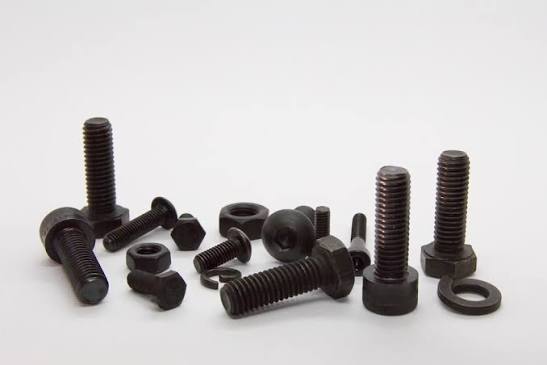
Supply of Industrial Fasteners
Bolts and nuts are recognized as the most critical and widely used connecting elements in all industries, responsible for joining components, transferring loads, and withstanding tensile, shear, and torque forces. These seemingly simple components play a vital role in the safety of structures, machinery, pressure equipment, and steel structures. The correct selection of bolts and nuts based on load type, environmental conditions, temperature, corrosion, and strength class ensures joint integrity and prevents catastrophic failures. Sourcing these products from reputable suppliers with quality documentation is of particular importance.
1. Types of Industrial Fasteners Based on Application and Design
- Machine Bolts & Screws:
- Hex Head Bolt: The most commonly used bolt type in industry with a hexagonal head, designed for use with wrenches. Compliant with
DIN 933(full thread) andDIN 931(partial thread). - Socket Head Cap Screw: Features a cylindrical head with a socket drive for high torque applications in confined spaces. Compliant with
DIN 912. - Flange Bolt: Features an integrated flange under the bolt head that eliminates the need for a washer and increases the bearing surface area.
- Eye Bolt and Hook Bolt: Used for lifting, rigging, and cable attachments.
- U-Bolt: Used for attaching pipes to structures, mounting tanks, and securing equipment.
- Hex Head Bolt: The most commonly used bolt type in industry with a hexagonal head, designed for use with wrenches. Compliant with
- Self-Tapping & Self-Drilling Screws:
- Self-Tapping Screw: Features sharp threads that penetrate sheet metal and plastics without pre-tapping.
- Self-Drilling / Tek Screw: Features a drill-shaped tip that performs both drilling and tapping operations simultaneously. Widely used in light steel structures and building facades.
- Structural Bolts:
- High-Strength Friction Grip (HSFG) Bolts: Used for heavy steel structure connections such as bridges and high-rise buildings. Compliant with
ASTM A325andASTM A490. - Anchor Bolts: Used for connecting structures to concrete foundations in L, J, Headed, and Hooked types.
- High-Strength Friction Grip (HSFG) Bolts: Used for heavy steel structure connections such as bridges and high-rise buildings. Compliant with
- Special and Specialty Fasteners:
- Stud Bolts: Threaded rods on both ends without a head, widely used in flanges and high-pressure connections per
ASTM A193 B7andASTM A320 L7. - Threaded Rod / All-Thread: Fully threaded rod for general construction and structural applications.
- Locking Screws: Feature nylon patches or special designs to prevent loosening due to vibration.
- Set Screw / Grub Screw: Headless screws used for securing components onto shafts.
- Stud Bolts: Threaded rods on both ends without a head, widely used in flanges and high-pressure connections per
2. Types of Nuts
- Hex Nut: The most common nut type per
DIN 934andISO 4032. - Nyloc Nut / Lock Nut: Features an internal nylon ring that prevents loosening due to vibration.
- Flange Nut: Features an integrated flange that increases the bearing surface and eliminates the need for a washer.
- Cap Nut / Acorn Nut: Features a dome-shaped cover to conceal the bolt end, providing a finished appearance and improved safety.
- Weld Nut: Designed for welding onto sheet metal to provide internal threads where back-side access is not available.
- Square Nut: Used in specialty applications requiring a larger bearing surface in confined spaces.
- Slotted Nut / Castle Nut: Used with shafts having cotter pin holes for pin or key installation.
- Heavy Hex Nut: Features larger height and dimensions for high-pressure applications per
ASTM A563.
3. Strength Grades and Property Classes
Fastener grades indicate minimum tensile strength, yield point, and chemical composition and are defined according to various standards:
- Carbon Steel Fasteners:
- Grade 2: Tensile strength 50,000 psi for general purpose and light-duty applications.
- Grade 5: Tensile strength 120,000 psi, the most widely used industrial grade with quench and temper heat treatment.
- Grade 8: Tensile strength 150,000 psi for heavy-duty and high-load applications in automotive and machinery industries.
- Alloy Steel High-Pressure Fasteners:
- ASTM A193 B7: The gold standard for flanges and pressure vessels, chrome-molybdenum (Cr-Mo) alloy steel with a tensile strength of 125,000 psi. Resistant to high temperatures up to 450°C.
- ASTM A193 B7M: Similar to B7 but with precise hardness control for sour service applications per
NACE MR0175. - ASTM A193 B16: For very high temperatures (up to 540°C) in boilers and power plants.
- ASTM A320 L7: Alloy steel resistant to low temperatures (down to -100°C) for LNG and cryogenic industries.
- ASTM A320 L7M: Controlled version for sour service at low temperatures.
- Structural Fasteners:
- ASTM A325: Tensile strength 120,000 psi for steel structure connections.
- ASTM A490: Tensile strength 150,000 psi for heavy structural connections.
- Stainless Steel Fasteners:
- A2-70 (304): Tensile strength 700 MPa, resistant to general corrosion.
- A4-70 (316): Tensile strength 700 MPa, resistant to chloride corrosion and marine environments.
- A4-80: Tensile strength 800 MPa for higher load applications.
- Nuts:
- ASTM A563: Standard for carbon and alloy steel nuts in various grades.
- ASTM A194 Grade 2H: Heavy hex nut for B7 bolts in flanges and pressure vessels.
- ASTM A194 Grade 7: Alloy steel nut for high temperatures.
- ASTM A194 Grade 4: 304 stainless steel nut.
- ASTM A194 Grade 8: 316 stainless steel nut.
4. Materials and Common Grades
- Carbon Steel:
- SAE 1008, 1010, 1018: For general purpose and light-duty fasteners.
- SAE 1035, 1038, 1045: For Grade 5 and 8 fasteners with heat treatment.
- SAE 4130, 4140, 4142: Cr-Mo alloy steel for A193 B7 and B16 fasteners.
- Stainless Steel:
- 304 / 304L (A2): Resistant to general corrosion, used in food and chemical industries.
- 316 / 316L (A4): Resistant to chloride corrosion and marine environments.
- 321: Resistant to intergranular corrosion at high temperatures.
- Special Alloys:
- Inconel 625, 718: For very high temperatures and corrosive environments in oil and gas industries.
- Monel 400, K500: For marine and acidic environments.
- Hastelloy C-276: For strong acids and highly corrosive conditions.
- Duplex 2205, Super Duplex 2507: For seawater and chloride environments.
- Titanium Grade 2, Grade 5: For chemical, marine, and aerospace industries.
- Non-Ferrous Metals:
- Brass: For electrical, marine, and decorative applications.
- Bronze: For marine environments and corrosion resistance.
- Aluminum: For lightweight applications in aerospace and automotive industries.
- Protective Coatings & Platings:
- Hot-Dip Galvanized: Excellent corrosion resistance for outdoor and structural applications.
- Electro-Galvanized: Thinner coating for indoor applications.
- Dacromet / Zinc Flake: Very high corrosion resistance without hydrogen embrittlement risk.
- Xylan / Teflon Coating: For chemical resistance and reduced friction.
- Cadmium Plating: For aerospace and marine industries.
5. Standards and Quality Control (QC)
- Dimensional Standards:
DIN 931, DIN 933: Hexagon head bolts (German)ISO 4014, ISO 4017: Hexagon head bolts (International)ASME B18.2.1: Square and Hex bolts (American)ASME B18.2.2: Hex nuts (American)DIN 912: Socket head cap screwsISO 4762: Socket head cap screws (International)ASME B18.3: Socket and cap screwsASTM A193 / A194: Alloy and stainless steel bolts and nutsASTM A325 / A490: Structural boltsASTM A563: Carbon and alloy steel nuts
- Thread Standards:
ISO 261 / ISO 262: Metric threads (M)ASME B1.1: Inch threads UNC, UNF, UNEFASME B1.20.1: NPT threads (tapered)
- Mandatory Tests:
- Tensile Test: Determines tensile strength, yield point, and elongation.
- Hardness Test: Ensures proper heat treatment per
ASTM E18(Rockwell) andASTM E384(Vickers). - Impact Test: For low-temperature fasteners per
ASTM A320. - Proof Load Test: Ensures no permanent deformation under specified load.
- Non-Destructive Testing (NDT): MT (Magnetic Particle) and PT (Liquid Penetrant) for critical fasteners.
- Chemical Analysis (PMI): Verification of material chemical composition.
- Coating Test: Thickness measurement of galvanized coating per
ASTM B695.
- Certifications:
- MTC 3.1 per
EN 10204: Mill Test Certificate - NACE MR0175 Certificate: For sour service applications
- ISO 898 Certificate: Mechanical properties of fasteners
- CE Marking Certificate: For European market
- MTC 3.1 per
6. Washers
Washers serve as complementary elements to bolts and nuts, playing a vital role in load distribution, surface protection, and locking of connections:
- Flat Washer: Provides uniform load distribution and prevents surface damage. Compliant with
DIN 125andASME B18.22.1. - Spring Washer / Lock Washer: Prevents bolt loosening due to vibration. Compliant with
DIN 127. - Toothed Lock Washer: Features sharp teeth that bite into both the component surface and beneath the nut.
- Belleville Washer / Disc Spring: Used for compensating thermal expansion and maintaining preload in critical connections.
- Fender Washer: Features a large outer diameter for load distribution on thin sheet metal.
7. Key Fastener Selection Parameters
- Load Type: Tensile, shear, torque, or combined.
- Load Magnitude: Precise calculation of forces acting on the connection.
- Environmental Conditions: Temperature, humidity, chemicals, marine or industrial environment.
- Connection Type: Permanent or removable, number of assembly cycles.
- Safety Requirements: Criticality of application (structural, pressure, dynamic).
- Required Standard: DIN, ISO, ASTM, ASME based on industry and region.
- Protective Coating: Based on environmental corrosion conditions.
8. Key Application Areas
- 🛢️ Oil, Gas, and Petrochemical Industries: Flanges, pressure vessels, heat exchangers, wellheads with A193 B7 bolts and A194 2H nuts.
- ⚡ Power Plants: Boilers, turbines, steam lines with B16 and L7 bolts for high and low temperatures.
- 🏗️ Steel Structures and Construction: Beam and column connections with A325 and A490 bolts.
- 🚢 Marine Industries: 316 stainless steel bolts and special alloys for seawater resistance.
- 🏭 Industrial Machinery: Grade 8 bolts for heavy loads and high vibration.
- 🚗 Automotive Industries: Special fasteners with precise grades for engines, chassis, and body.
- 🍔 Food and Pharmaceutical Industries: 316 stainless steel fasteners with polished surfaces and FDA approval.
- ⛏️ Mining Industries: Wear and corrosion-resistant fasteners for heavy equipment.
- 🔋 Energy Industries: Titanium and Inconel fasteners for specialty conditions.
9. Advantages of Procuring Through a Specialized Trading Company
- Comprehensive Product Range: Access to a wide variety of fasteners in all sizes, grades, materials, and standards from metric to inch.
- Guaranteed Authenticity and Quality: Products sourced from reputable manufacturers with MTC 3.1 certificates and tensile/hardness test reports.
- Expert Technical Consultation: Assistance in selecting the correct grade, material, and coating based on operating conditions to prevent joint failure.
- Complete Package Supply: Provision of bolts, nuts, washers, and rings as complete kits for large-scale projects.
- Custom Manufacturing: Capability to produce special fasteners based on drawings and customer requirements.
- Competitive Pricing and On-Time Delivery: Supply chain and logistics management for rapid shipping nationwide.
- EPC Project Support: Capability to supply complete project bolting lists per engineering specifications.
Order Registration and Equipment Supply Process
At Negin Javid Rasta, the order registration and industrial equipment supply process is designed in a phased, transparent, and engineering-driven manner to enable employers and contractors to procure the necessary equipment for their projects with full confidence and in the shortest possible time.
This process is implemented with the aim of reducing technical risks, preventing errors in equipment selection, and ensuring on-time delivery.
Order Registration and Equipment Supply Steps at Negin Javid Rasta:
1. Request Submission and Technical Specifications
Receiving the supply request along with the datasheet, drawing, or required project specifications.
2. Technical Review and Specification Matching
Precise evaluation of project needs by technical experts and proposing the best options.
3. Price and Delivery Time Quotation
Issuing a transparent proforma invoice including price, supply terms, and delivery schedule.
4. Equipment Procurement and Quality Control
Sourcing equipment from reliable sources and conducting quality checks prior to shipment.
5. Shipment, Delivery, and Support
Delivery of equipment according to schedule and providing technical support if needed.
Through this structured process, Negin Javid Rasta strives to provide a fast, reliable, and hassle-free experience for employers in the field of industrial equipment supply.