

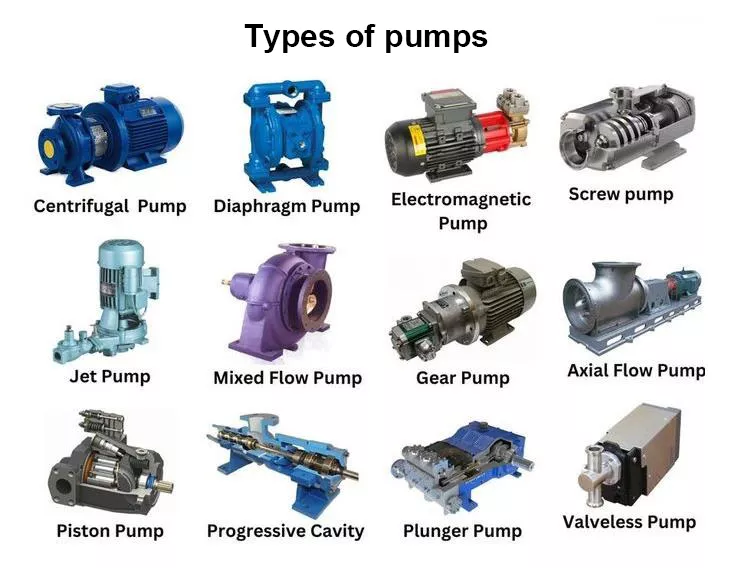
Types of Industrial Pumps
Industrial pumps are recognized as the beating heart of all fluid transfer systems across various industries, responsible for increasing pressure and transferring liquids, slurries, corrosive chemicals, viscous fluids, and even gas-liquid mixtures from one point to another. The correct selection of a pump based on fluid type, required flow rate, pumping head, viscosity, temperature, pressure, and environmental conditions has a direct impact on energy efficiency, operating costs, equipment lifespan, and process safety. Pumps are divided into two main categories: Dynamic and Positive Displacement, each with diverse subcategories.
1. Centrifugal Pumps
Centrifugal pumps are the most widely used type of pump in the world, utilizing centrifugal force generated by the rotation of an impeller to transfer kinetic energy to the fluid and convert it into pressure energy. These pumps are ideal for high flow rates and medium heads.
- Single-Stage Centrifugal Pump: Features one impeller and one volute casing. Suitable for low to medium heads (up to approximately 100 meters) and high flow rates. Widely used in water supply systems, building services, and general industries. Compliant with
ISO 2858andEN 733. - Multi-Stage Centrifugal Pump: Features multiple impellers in series on a single shaft, with each stage increasing the fluid pressure. Suitable for very high heads (up to 1000 meters and beyond) such as boiler feed, reverse osmosis (RO), high-rise building water supply, and pressurized irrigation. Compliant with
API 610 BB4/BB5. - Double Suction / Split Case Pump: The impeller draws fluid from both sides, providing axial thrust balance and reduced vibration. Suitable for very high flow rates in water pumping stations, power plant cooling systems, and steel industries. Compliant with
API 610 BB1/BB2. - Self-Priming Pump: Capable of evacuating air from the suction line and starting pumping without manual priming. Ideal for suction from below-grade tanks, well drainage, and mobile applications.
- Magnetic Drive / Sealless Pump: Without a mechanical seal, with torque transmitted via magnetic field. Complete leak elimination, ideal for highly toxic, corrosive, volatile, and hazardous fluids. Compliant with
API 685. - End Suction Pump: The simplest and most common design with axial suction and radial discharge. Easy installation, simple maintenance, and economical pricing. Compliant with
ISO 2858andANSI B73.1.
2. Positive Displacement Pumps
These pumps operate by trapping a fixed volume of fluid and forcibly displacing it towards the discharge. Unlike centrifugal pumps, the flow rate of these pumps is nearly independent of discharge pressure, making them suitable for viscous fluids, shear-sensitive fluids, and precise flow rates.
- Gear Pump:
- External Gear: Two meshing gears that carry fluid between the teeth and the housing. Suitable for oils, fuel, resin, and viscous fluids. Working pressure up to 250 bar.
- Internal Gear: Features an internal gear and a crescent. More uniform flow and quieter operation. Suitable for food, chemical, and paint industries.
- Screw Pump:
- Progressive Cavity / Mono Pump: Features a metal helical rotor rotating inside a rubber stator. Ideal for highly viscous fluids, slurries, sludge, and materials containing solid particles. Completely pulse-free flow. Compliant with
API 676. - Twin/Triple Screw: For high flow rates and medium pressures in crude oil transfer, heavy fuel, and hydraulic oils. Compliant with
API 676.
- Progressive Cavity / Mono Pump: Features a metal helical rotor rotating inside a rubber stator. Ideal for highly viscous fluids, slurries, sludge, and materials containing solid particles. Completely pulse-free flow. Compliant with
- Piston & Plunger Pump:
- Axial Piston: Very high pressures (up to 700 bar and higher) with variable flow. Widely used in industrial and mobile hydraulic systems.
- Plunger / Triplex: Features three or five plungers to generate ultra-high pressures (up to 2500 bar). Used in industrial waterjet, chemical injection, oil well acidizing, and reverse osmosis systems. Compliant with
API 674.
- Diaphragm Pump:
- Air Operated Double Diaphragm (AODD): Operates using compressed air. Explosion-proof, self-priming, portable, and suitable for a wide range of fluids including acids, solvents, paint, and slurries. No electricity required.
- Mechanical and Hydraulic Diaphragm (API 675): For precise chemical dosing with flow rate adjustable from 0 to 100%. Used in water treatment, corrosion inhibitor injection, and pharmaceutical industries.
- Lobe Pump: Features two or more lobe-shaped rotors that rotate without contacting each other. Gentle flow without damaging the fluid. Ideal for food industries (milk, cream, chocolate), pharmaceutical, and sanitary applications. Certified with
3-AandFDAstandards. - Peristaltic / Hose Pump: The fluid only comes into contact with the internal rubber tube and is displaced by compression rollers. Complete elimination of cross-contamination, suitable for abrasive, corrosive, and sterile fluids. Used in mining, water treatment, and pharmaceutical industries.
3. Special and Specialty Pumps
- Submersible Pumps:
- Deep Well Submersible: Motor and pump are integrated and submerged within the well. Suitable for extracting water from deep wells (up to 500 meters and deeper), agricultural irrigation, and municipal water supply.
- Submersible Slurry/Sewage Pump: Features abrasion-resistant impellers and the ability to pass large solid particles. Suitable for sewage discharge, sludge, muddy water, and mining ponds.
- Explosion Proof Submersible Pump: Certified with
ATEXandIECExfor use in hazardous environments such as wastewater treatment plants and oil facilities.
- Vertical Pumps:
- Vertical Turbine Pump (VTP): Impellers are located inside the suction pipe and submerged in water. Suitable for pumping stations drawing water from rivers, dams, and large wells. Compliant with
API 610 VS1. - In-Line Vertical Pump: Installed directly on the pipeline with no need for a separate foundation. Saves installation space. Suitable for building services and HVAC systems.
- Vertical Turbine Pump (VTP): Impellers are located inside the suction pipe and submerged in water. Suitable for pumping stations drawing water from rivers, dams, and large wells. Compliant with
- Vacuum Pumps:
- Liquid Ring Vacuum Pump: Utilizes a liquid ring (usually water) as a sealant. Suitable for medium vacuum and wet or corrosive gases. Used in chemical, paper, and power industries.
- Rotary Vane Vacuum Pump: For high vacuum (down to 0.001 mbar). Used in vacuum packaging, dryers, and distillation systems.
- Dry Screw Vacuum Pump: Oil-free and suitable for clean environments such as pharmaceutical, semiconductor, and food industries.
- Fire Pumps: Designed according to
NFPA 20andUL/FMstandards. Includes electric, diesel, and jockey pumps to provide the required pressure and flow for sprinkler, hose reel, and hydrant systems. - Metering / Dosing Pumps: For precise and adjustable injection of very small quantities of chemicals (such as chlorine, corrosion inhibitors, antiscalants, and polyelectrolytes). Dosing accuracy up to ±1%. Compliant with
API 675.
4. Common Pump Materials and Grades
The selection of casing, impeller, shaft, and seal materials is based on fluid type, corrosivity, temperature, and pressure:
- Cast Iron (GG25/GGG40): For clean water and non-corrosive fluids at normal temperatures. Economical and widely used.
- Carbon Steel (WCB/A216): For oil, gas, and steam at higher pressures and temperatures.
- Stainless Steel (SS 304/316/316L/904L): For corrosive fluids, food, and pharmaceutical industries. Excellent corrosion resistance.
- Nickel Alloys (Hastelloy C-276, Inconel, Monel): For strong acids, chloride environments, and highly corrosive conditions.
- Duplex and Super Duplex (Duplex 2205, Super Duplex 2507): For seawater and high-chloride environments with resistance to pitting and crevice corrosion.
- Titanium Alloys (Titanium Gr.2/Gr.5): For seawater, oxidizing acids, and specialty chemical applications.
- Polymers and Plastics (PP, PVDF, PTFE, PVC): For dilute acids and bases at low temperatures. Lightweight and economical.
- Ceramics and Silicon Carbide (SiC): For wear-resistant parts such as impellers and liners in slurry pumps.
5. Sealing Systems
- Mechanical Seal: The most common sealing system in modern industrial pumps. Consists of two polished faces (one stationary, one rotating) that are pressed together by spring or hydraulic pressure. Available in Single, Double/Tandem, and Cartridge configurations. Compliant with
API 682. - Gland Packing: A more traditional method using braided packing impregnated with graphite or PTFE. Requires periodic adjustment and allows controlled leakage for cooling.
- Seal Flush Plans: According to
API Plan 11, 21, 23, 32, 52, 53, 54for cooling, flushing, and lubricating mechanical seals under harsh operating conditions.
6. Standards and Quality Control (QC)
- Design and Manufacturing Standards:
API 610(Centrifugal Pumps for Petroleum and Gas Industries),API 674(Reciprocating Pumps),API 675(Metering Pumps),API 676(Rotary Pumps),API 685(Sealless Pumps),ISO 2858(General Centrifugal Pumps),ISO 5199(Chemical Pumps),ANSI B73.1(Process Pumps). - Performance Testing Standards:
ISO 9906(Hydraulic Performance Testing),API 610(Performance Testing at BEP conditions),HI 14.6(Hydraulic Institute Standard). - Key Testing Parameters: Performance Curve including flow-head, flow-power, flow-efficiency, and flow-NPSHr relationships. Testing at a minimum of 5 operating points from shut-off to maximum flow.
- Mechanical Tests: Vibration Test per
ISO 10816, Noise Level Test, Rotor Dynamic Balancing Test perISO 1940, and Casing Hydrostatic Test. - Certifications: Provision of MTC 3.1, Performance Test Certificate, ATEX certification for explosive atmospheres, and NACE MR0175 certification for sour service applications.
7. Key Pump Selection Parameters
- Flow Rate (Q): Required fluid volume per unit time (m³/h, l/min, GPM).
- Head (H): The equivalent pressure height the pump must generate (meters of water column). Includes static head, friction head, and velocity head.
- NPSH (Net Positive Suction Head): The most critical parameter for preventing cavitation. NPSHa (available in the system) must always exceed NPSHr (required by the pump).
- Efficiency (η): The ratio of useful hydraulic power to the electric motor’s power consumption. Selecting the pump at the Best Efficiency Point (BEP) reduces energy consumption and increases pump lifespan.
- Fluid Viscosity: Direct impact on pump type selection. High-viscosity fluids (above 200 cSt) typically require positive displacement pumps.
- Operating Temperature: Impacts material selection, seal type, and cooling system requirements.
- Fluid Type: Corrosivity, abrasiveness, toxicity, flammability, and presence of solid particles.
8. Key Application Areas
- 🛢️ Oil, Gas, and Petrochemical Industries: Process pumps, crude oil transfer, chemical injection, boiler feed pumps, and loading pumps.
- ⚡ Thermal and Combined Cycle Power Plants: Boiler Feed Pumps (BFP), circulation pumps, cooling water pumps, and condensate pumps.
- 💧 Water and Wastewater Industries: Raw water pumping stations, treatment plants, sludge pumps, chlorine and polyelectrolyte dosing pumps.
- 🏭 Chemical and Pharmaceutical Industries: Acid and base transfer, reactors, CIP/SIP systems, and sterile pumps.
- ⛏️ Mining and Steel Industries: Slurry pumps, pulp pumps, tailings pumps, and mine dewatering pumps.
- 🌾 Agriculture and Irrigation: Deep well pumps, pressurized irrigation pumps, river and dam water transfer pumps.
- 🏗️ Building and Facilities Industries: Water booster pumps, heating circulation pumps, fire pumps, and pool pumps.
- 🚢 Marine and Shipbuilding Industries: Ballast pumps, seawater pumps, fuel pumps, and bilge pumps.
- 🍔 Food and Beverage Industries: Sanitary pumps, lobe pumps, diaphragm pumps, and CIP pumps.
9. Advantages of Procuring Through a Specialized Trading Company
- Supply of Reputable Global Brands: Access to genuine products from leading brands such as Grundfos, KSB, Sulzer, Flowserve, WILO, Ebara, ITT Goulds, Sundyne, Verder, Wilden, Allweiler with authenticity guarantee and warranty.
- Technical Consultation and Optimal Selection: Assistance in hydraulic calculations, system curve plotting, and pump selection at the BEP point to optimize energy consumption and prevent cavitation and vibration issues.
- Complete Skid-Mounted Packages: Supply of pumps complete with electric motor, coupling, baseplate, guard, valves, instrumentation, and control panel as an integrated, ready-to-install package.
- After-Sales Service and Spare Parts: Fast supply of impellers, mechanical seals, bearings, shafts, and liners to minimize production line downtime.
- Competitive Pricing and On-Time Delivery: Supply chain and logistics management for safe and rapid shipping of pumps nationwide.
- EPC Project Support: Capability to supply complete project pump lists in accordance with engineering specifications and client standards.
Order Registration and Equipment Supply Process
At Negin Javid Rasta, the order registration and industrial equipment supply process is designed in a phased, transparent, and engineering-driven manner to enable employers and contractors to procure the necessary equipment for their projects with full confidence and in the shortest possible time.
This process is implemented with the aim of reducing technical risks, preventing errors in equipment selection, and ensuring on-time delivery.
Order Registration and Equipment Supply Steps at Negin Javid Rasta:
1. Request Submission and Technical Specifications
Receiving the supply request along with the datasheet, drawing, or required project specifications.
2. Technical Review and Specification Matching
Precise evaluation of project needs by technical experts and proposing the best options.
3. Price and Delivery Time Quotation
Issuing a transparent proforma invoice including price, supply terms, and delivery schedule.
4. Equipment Procurement and Quality Control
Sourcing equipment from reliable sources and conducting quality checks prior to shipment.
5. Shipment, Delivery, and Support
Delivery of equipment according to schedule and providing technical support if needed.
Through this structured process, Negin Javid Rasta strives to provide a fast, reliable, and hassle-free experience for employers in the field of industrial equipment supply.